BioHavens are classified as Floating Treatment Wetlands, providing the ecological services of a natural wetland with extra benefits
What is a Wetland?
A wetland is an ecosystem that supports both aquatic and land species. It is an area where water covers the soil or is near the surface of the soil at varying times of year. There are many different types of wetlands, including vernal pools, cattail marshes, shrub bogs, peatlands, and white-cedar swamps. All of them are premier habitats.
Why Are Wetlands Important?
Wetlands are necessary to sustain living organisms, to maintain balance of nutrients in soil and water, to contain carbon emissions, and to filter and trap moving sediments. They provide habitat for waterfowl and other game, are nurseries for fish, and help to control flooding. Most importantly, they clean water by absorbing it like a sponge, "scrubbing" it through microbial action then releasing it.
The biodiversity present in wetlands supports populations of insects, crawfish and small fish, like minnows, which sustain larger fish and still larger ones. Of course these fish are sustenance for birds, bears, amphibians, etc. The food chain is supported by wetlands.
Wetlands are home to 31 percent of the United States’ plant species, and up to one-half of North American bird species nest or feed in wetland.
The biodiversity present in wetlands supports populations of insects, crawfish and small fish, like minnows, which sustain larger fish and still larger ones. Of course these fish are sustenance for birds, bears, amphibians, etc. The food chain is supported by wetlands.
Wetlands are home to 31 percent of the United States’ plant species, and up to one-half of North American bird species nest or feed in wetland.
What Lives In A Wetland?
Wetlands are inhabited by flowers and plants, trees (at least 2 bald cypress trees older than 2000 years old live in swampland along the Black River in southeastern North Carolina) and shrubs, aquatic species, insect populations, alligators, snakes, turtles, newts, salamanders and other reptiles and amphibians. Invertebrates, such as crayfish, shrimp, mosquitoes, snails and dragonflies, also live in wetlands. Birds including plover, grouse, pheasant, storks, herons and other waterfowl are often nesting and hunting for food in a wetland.
Wetlands are also home to invertebrate populations too tiny to be perceived by the human eye, and all kinds of mammals, including rodents, otter, beaver, raccoon, coyotes, bobcats, and muskrats. And, if you live in Australia, platypus!
Rare species are often concentrated in wetlands. A disproportionate number of endangered animals and plant species are dependent on wetland ecology.
Wetlands are also home to invertebrate populations too tiny to be perceived by the human eye, and all kinds of mammals, including rodents, otter, beaver, raccoon, coyotes, bobcats, and muskrats. And, if you live in Australia, platypus!
Rare species are often concentrated in wetlands. A disproportionate number of endangered animals and plant species are dependent on wetland ecology.
Why Are Wetlands Threatened?
Wetland habitats are the habitats most commonly recognized by the public and conservation agencies as threatened. The federal Clean Water Act and state laws were enacted in the twentieth century to protect wetlands. Wetland loss is due to destruction, degradation, and pollution, mostly human-induced.
In 1989, a study showed that more than 87% of wetland losses are attributable to agriculture (Nelson 1989).
Development is a threat to wetlands. They are degraded or destroyed by chemical spills, an excess of nutrients from fertilizer runoff, and the intrusion of invasive species. When sea levels rise, salt water can intrude and add too much salination to the wetland.
If you ever doubt the importance of a healthy wetland, just visit an unhealthy one. In an unhealthy wetland, where oxygen has been depleted, you might find dead fish or dead birds, the result of cyanobacteria or other anaerobic issues.
In 1989, a study showed that more than 87% of wetland losses are attributable to agriculture (Nelson 1989).
Development is a threat to wetlands. They are degraded or destroyed by chemical spills, an excess of nutrients from fertilizer runoff, and the intrusion of invasive species. When sea levels rise, salt water can intrude and add too much salination to the wetland.
If you ever doubt the importance of a healthy wetland, just visit an unhealthy one. In an unhealthy wetland, where oxygen has been depleted, you might find dead fish or dead birds, the result of cyanobacteria or other anaerobic issues.
Should Humans Protect Wetlands? Can We?
Yes and yes. Degradation of ecosystems such as wetlands leads to ecological changes that disturb human life and wellbeing as well as disrupt nature’s processes. The fish, birds, bats, and amphibians that are supported by wetland habitat help to control the nuisance insect population (like mosquitos and midge flies).
An acre of wetland can store 1 to 1.5 million gallons of floodwater, protecting the surrounding area from flooding. Wetlands slow down soil erosion by slowing the speed of the water passing through them when streams overflow into wetlands. Wetlands help replace water in underground sources and reservoirs by holding it after rainfall and slowly releasing it into the ground.
Another reason to restore wetlands and build habitats is that they sequester greenhouse gas (GHG) emissions.
These are some pretty good reasons.
So, yes, we can protect and restore wetlands.
An acre of wetland can store 1 to 1.5 million gallons of floodwater, protecting the surrounding area from flooding. Wetlands slow down soil erosion by slowing the speed of the water passing through them when streams overflow into wetlands. Wetlands help replace water in underground sources and reservoirs by holding it after rainfall and slowly releasing it into the ground.
Another reason to restore wetlands and build habitats is that they sequester greenhouse gas (GHG) emissions.
These are some pretty good reasons.
So, yes, we can protect and restore wetlands.
How are BioHaven Floating Islands Related to Wetlands?
BioHaven Floating Islands are an example of a Floating Treatment Wetland (FTW), a classification described in a scientific journal article on the taxonomy of treatment wetlands, published in 2013. They are a way to compensate for the critical loss of premier natural wetlands. They can establish wetland function in virtually any body of water, and offer many advantages over natural wetlands, such as the ability for plants to establish a deep and bushy root biomass that is suspended in the water column. They slow down the flow of water, as a wetland does, and contribute to sedimentation, while biologically digesting organic particles. Unlike a natural wetland, which can become anaerobic, they promote aerobic conditions deep in the water column and can be readily enhanced with mechanical circulation and aeration.
BioHavens offer a "concentrated wetland effect." By this we mean that they have a very high ratio of surface area to physical footprint. Think of them as a thick filter, made from the same resilient plastic that drinking water bottles are made of. Unlike wetlands rooted in the soil, BioHavens are permeable and float at the surface of the water column, safe from inundation. They can be made in a variety of depths to suit the water body they are placed in. The plant roots growing beneath them reach down as much as one meter or more.
Islands are permeable, like the riparian edge of the naturally-occurring floating islands that they biomimic, and provide a safe haven for a vast range of pollinators and invertebrates. They attract beneficial insects, frogs, fish, and other species that eat mosquitoes and larvae and are useful in vector control. The fibrous island matrix provides security and nesting habitat for nymphs and adult insects alike.
Fish Fry Lake, our research lake, has received dozens of BioHavens over the last ten years, mostly prototypes. There is a lot of concentrated wetland effect to be seen! Each summer, there are times when it is bright blue with a damselfly hatch. These guys are accidental pollinators, so fortunately there are also bees and the thousands of other insects that are far more purposeful about pollinating. There will be times when a dozen different pollinators are weaving between blossoms on either side of a floating walkway or StreamBed.
There is an insect that’s missing from this scenario. The best place to be in Shepherd, Montana, where there is flood irrigation, cattle stock ponds, water tanks and such occur, is on Fish Fry Lake. The reason becomes crystal clear when you track the life model of damsel and dragonfly in their nymph stage. They look like miniature dragons, and are almost as fast in the water as when they transition to their flight stage. And they love to eat mosquitoes. They don’t just consume mosquito larvae, but also take mosquitoes on the wing. When you watch a dragonfly in flight you can barely track it with the naked eye when it’s in “fast” mode. Catching mosquitoes is easy for them.
BioHavens offer a "concentrated wetland effect." By this we mean that they have a very high ratio of surface area to physical footprint. Think of them as a thick filter, made from the same resilient plastic that drinking water bottles are made of. Unlike wetlands rooted in the soil, BioHavens are permeable and float at the surface of the water column, safe from inundation. They can be made in a variety of depths to suit the water body they are placed in. The plant roots growing beneath them reach down as much as one meter or more.
Islands are permeable, like the riparian edge of the naturally-occurring floating islands that they biomimic, and provide a safe haven for a vast range of pollinators and invertebrates. They attract beneficial insects, frogs, fish, and other species that eat mosquitoes and larvae and are useful in vector control. The fibrous island matrix provides security and nesting habitat for nymphs and adult insects alike.
Fish Fry Lake, our research lake, has received dozens of BioHavens over the last ten years, mostly prototypes. There is a lot of concentrated wetland effect to be seen! Each summer, there are times when it is bright blue with a damselfly hatch. These guys are accidental pollinators, so fortunately there are also bees and the thousands of other insects that are far more purposeful about pollinating. There will be times when a dozen different pollinators are weaving between blossoms on either side of a floating walkway or StreamBed.
There is an insect that’s missing from this scenario. The best place to be in Shepherd, Montana, where there is flood irrigation, cattle stock ponds, water tanks and such occur, is on Fish Fry Lake. The reason becomes crystal clear when you track the life model of damsel and dragonfly in their nymph stage. They look like miniature dragons, and are almost as fast in the water as when they transition to their flight stage. And they love to eat mosquitoes. They don’t just consume mosquito larvae, but also take mosquitoes on the wing. When you watch a dragonfly in flight you can barely track it with the naked eye when it’s in “fast” mode. Catching mosquitoes is easy for them.
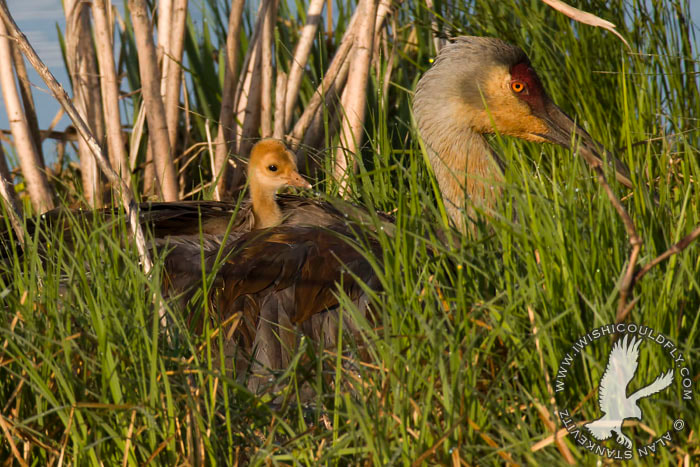
Sandhill Cranes successfully nesting on a BioHaven Floating Island
|
A Success Story: Sandhill Cranes nesting on BioHaven Floating Islands in a wetland in Barrington, Illinois (just outside of Chicago). The Sandhill Crane was close to extinction in the 1930s due to human infringement on their territory and hunting. Their comeback is definitely a conservation win. Wetlands conservation has played a major role in the health of Sandhill Cranes.
Please request our case study for more information. |