FLOATING ISLAND INTERNATIONAL
  • Home
  • Solutions
    • Ponds & Lakes
    • Harmful Algae
    • Methane Mitigation
    • Shoreline & Asset Protection
    • Stormwater
    • Wastewater
    • Habitat
  • Technology
    • BioHaven
    • StreamBed Oxygenation
    • Floating Solar
    • Biofilm
    • BioHavens & Plastics
    • Wetlands
  • BioHaven Options
    • Products
    • DIY Planting & Launching
  • Research
    • Featured Case Studies
    • Study Summaries
    • Research Papers
  • Press
    • Articles
    • Featured Writings
    • Latest Posts
    • Guest Posts
    • Podcasts
  • Contact Us
    • Search
  • Home
  • Solutions
    • Ponds & Lakes
    • Harmful Algae
    • Methane Mitigation
    • Shoreline & Asset Protection
    • Stormwater
    • Wastewater
    • Habitat
  • Technology
    • BioHaven
    • StreamBed Oxygenation
    • Floating Solar
    • Biofilm
    • BioHavens & Plastics
    • Wetlands
  • BioHaven Options
    • Products
    • DIY Planting & Launching
  • Research
    • Featured Case Studies
    • Study Summaries
    • Research Papers
  • Press
    • Articles
    • Featured Writings
    • Latest Posts
    • Guest Posts
    • Podcasts
  • Contact Us
    • Search

Of cockroaches, humans and zucchini

8/30/2023

1 Comment


Aquatic methane is emerging as a primary cause of climate change

​Gaia could be humming a tune called “We’ve been here before, folks!”  She could be crying tears of frustration, but probably not.  After all, this planet has been around for some time, during which climatic shifts have happened.  One event, which we humans refer to as the Great Permian extinction event, saw 94% of species die out.  That one occurred over the course of 300,000 years, though.  Plenty of time for the species in question to have prepped for their demise.  Not so right now.
​During the Great Permian Extinction Event, the planet’s temperature increased by 10 degrees centigrade.  Even that doesn’t sound like an unbearable number, until you add it up.  Take a not-untypical summer day, where the thermostat reads 39C / 102F.  Simple addition puts you at 49C /120F. Even prodigious zucchini won’t come through that heat.  

Coral doesn’t either.  It dies off at around 101F.  Only the most resilient species passes such a temperature swing off as “just another heat wave.”  We humans are versatile and resilient.  We live on every continent.  We might as well be the ubiquitous cockroach, for our adaptability.  A government trapper I met once predicted that at the end of this current extinction event there would be three critters interfacing on some bald knob…cockroaches, coyotes, and human beings.  If there’s a fourth, I vote for zucchini!
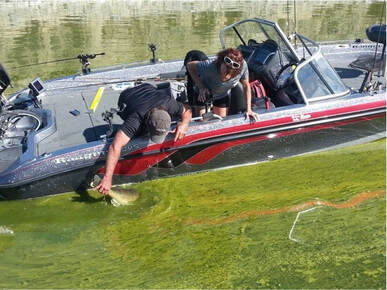
PictureA walleye being released into an algae bloom in Canyon Ferry, MT
​​

​​Cyanobacteria and bio-slime are even more resilient than our knob denizens, however. They were probably here at the very beginnings of life on this planet.  They’re here now too, in spades.  They are perfectly suited for survival under duress.  
Humans try to control bio-slime.  Hammering it with toxic chemicals is a preferred approach.  And sure, the poison kills it.  But then it settles onto the bottom of the waterway, providing feedstock for methanogens, that generate methane.  This is perfect, for the cyanobacteria.  It cycles into more climate warming, as methane is 81 times more effective than regular carbon dioxide.  Talk about shooting yourself in the foot!

Here’s an interesting tidbit.  If the waterway being treated doesn’t have quite enough copper in its diet, instead of producing methane, such systems instead generate nitrous oxide.  Laughing gas, which dwarfs methane’s impact in terms of climate change.  Think 300 times more impactful than carbon dioxide.

So here’s the good news…we know how to steward water gracefully.  We actually have lots of examples of such stewardship.  And no, it doesn’t include toxic chemical treatment.  
Picture
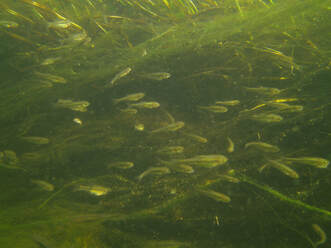
​Food webs can be energized.  They can cycle all those extra nutrients into higher-order life forms than cyanobacteria, given an appropriate stewardship nudge.  This usually takes the form of dissolved oxygen.  Not a big deal.  Not that hard.  Just good design work.
​Fresh water will be the first habitat to succumb to poor stewardship.  It is essentially the transition habitat between terrestrial and marine life.  The bad news is that it is extremely vulnerable to degradation.  The good news is that it responds to graceful stewardship quickly.

Even though fresh water only covers 6% of Gaia’s surface, it is a marker for how we humans are doing.  If it is healthy, so are we.  If instead it’s been allowed to degrade into nothing other than a methane factory, it will presage our demise.
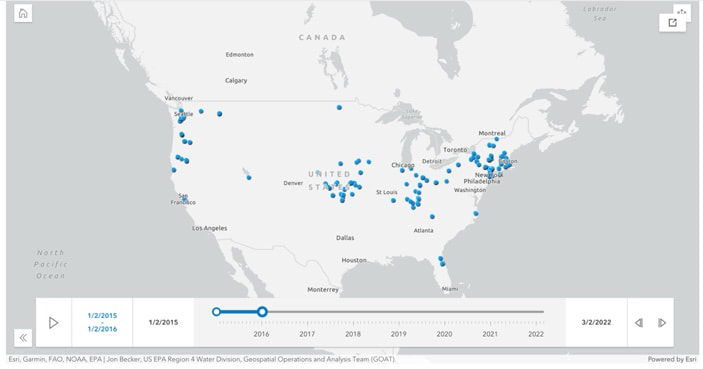
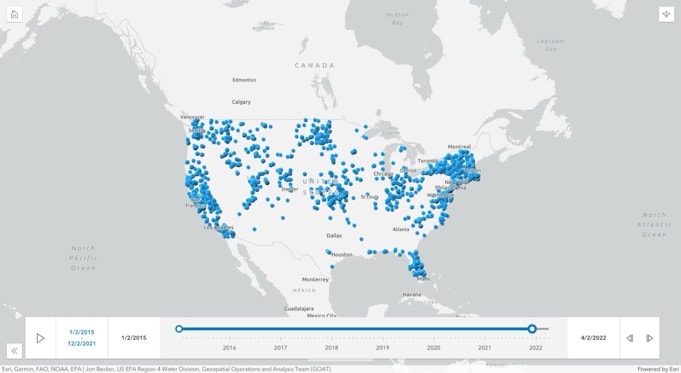
The incidence of reported HABs in 2016 (left) and in 2021 (right) - ​(CyanoMap).
​Today methane accounts for 13% of greenhouse gas impact.  As the algae maps indicate, we’d best get on the stick!  

Email me or call me if you are ready to act.
1 Comment
www.roofingsurreybc.com link
11/28/2023 04:33:28 am

Super nice! Thank you so much for being able to share this to the public.

Reply


Leave a Reply.

    Author

    Write something about yourself. No need to be fancy, just an overview.

    Archives

    January 2025
    August 2023
    February 2023
    October 2022
    September 2022
    July 2022
    January 2022
    December 2021
    October 2021
    August 2021
    July 2021
    June 2021
    May 2021
    April 2021
    March 2021
    February 2021
    January 2021
    December 2020

    Categories

    All
    Basic Health
    Biocomplexity
    BioHaven Technology
    Biomimicry
    Clean Water
    Climate Action
    Environmental Justice
    Eutrophic Water
    Fish Production
    Floating Photovoltaic
    Floating Solar
    Green House Gasses
    Habitat Creation
    Methane Emissions
    Mosquito Control
    Natural Beauty
    Natural Solutions
    Nature As Model
    Nature-as-model
    Nature's ROI
    Nutrient Pollution
    Solar Energy
    Urban Green Space
    Water Stewardship

    RSS Feed

Home
Stewardship
Case Studies
Floating Solar
Storm Water
Articles
Wastewater
Technology
Testimonials
Shoreline
Products
About Us
HAB's
Research
Partners
Contact Us
In the News
Blog

© Copyright Floating Island International, Inc. All Rights Reserved - Privacy Policy